




AG Ptok
Research Focus
Computational Virology
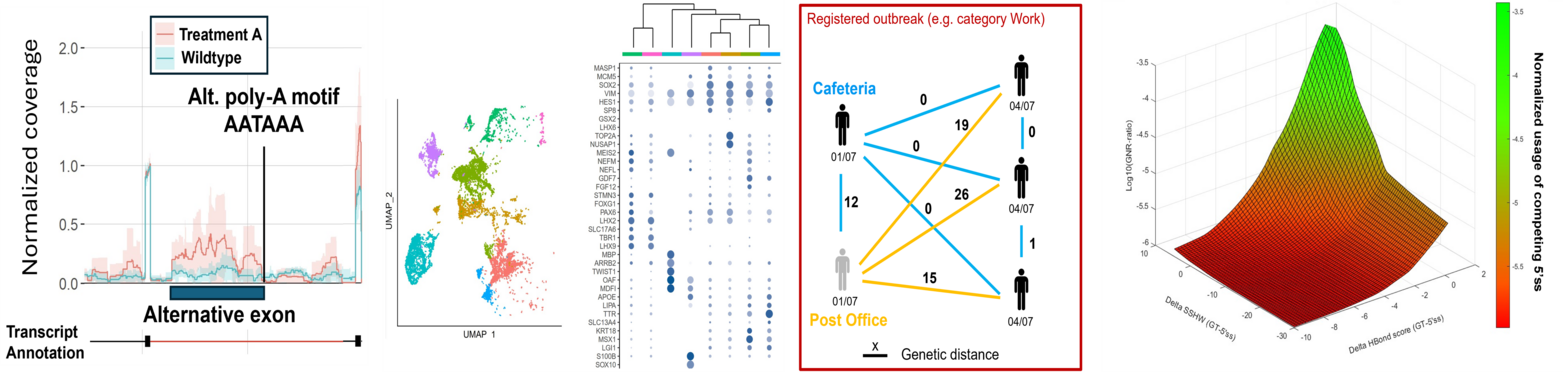
Our research focuses on how viruses exploit and disrupt mRNA splicing and RNA nuclear export pathways to enhance viral protein expression, increase replication and evade immune responses. We analyze long-read and short-read RNA and DNA sequencing data from public archives as well as from our own experiments to gain a better understanding of sequence elements that regulate mRNA splicing and RNA export, with a special emphasis on the recruitment of RNA-binding proteins (RBPs) by these elements and the ways in which viruses alter this process. Another key focus of our group is the analysis of sequence variations in viral genomes and what we can learn from them. Large datasets of viral genomes, sequenced at our institute, allow us to search for HLA-associated mutations (HCV, HBV), to study what viral quasispecies can tell us about disease progression (JCV), and to analyze how genomics-enhanced contact tracing can improve the investigation of institutional outbreaks as well as the tracing of population transmission chains (SARS-CoV2).
Splicing, originally discovered while studying the processing of type II adenovirus mRNA transcripts, proved to be a step in precursor mRNA maturation that affects almost all human genes. It describes a cellular process in which continuous sequence segments, called introns, are removed from the precursor RNA transcript, while the remaining sequence segments, called exons, are joined together. Variations in intronic boundary selection enable the production of various mature mRNA isoforms, potentially encoding different protein isoforms, originating from the same precursor mRNA. This process, called alternative splicing, can be found in most higher eukaryotes and affects around 95% of human genes. Beyond the splice site sequences themselves, splice site usage is further influenced by splicing regulatory elements (SREs) that recruit splicing regulatory proteins (SRPs), such as serine/arginine rich proteins (SR proteins) or heterogeneous nuclear ribonucleoproteins (hnRNPs). Depending on their binding position, these proteins can enhance or repress splice site usage and also play key roles in regulating nuclear RNA export. For instance, certain hnRNPs that contain a nuclear retention sequence (NRS), such as hnRNP C, can actively repress mRNA export by retaining transcripts within the nucleus until they are removed from the RNA, usually during excision of intronic sequences. On the other hand, some SR proteins, like SRSF3, serve as adapter proteins for Nuclear RNA Export Factor 1 (NXF1), facilitating the efficient and selective transport of RNA transcripts from the nucleus to the cytoplasm. During viral infection, the expression and activity of these regulatory proteins are often modulated directly by viral proteins to disrupt host cell RNA splicing and export. In addition, they are also regulated in the context of the cellular immune response to adjust alternative splicing and export of host cell transcripts.
We currently apply the HEXplorer algorithm, which was developed in the lab of Prof. Dr. Heiner Schaal, to estimate the pathological impact of viral or human sequence variations within SREs (https://rna.hhu.de/HEXplorer/). However, the HEXplorer and similar tools currently do not account for context-dependent changes in SRP activation during viral infection. Our group is therefore developing HEXplorer-based models that incorporate SRP activation profiles, which differ across cell types and change in response to viral infection or immune stimulation, such as exposure to type I interferons.
By focusing on the molecular dialogue between virus and host, through the analysis of viral genome sequence variations and RNA processing, we aim to uncover both fundamental principles of gene regulation and actionable insights into viral pathogenesis. The HBond score and the HEXplorer tool, developed in the laboratory of Prof. Dr. Heiner Schaal, along with our in-house tools VarCon, ModCon, and NCCRmap are available at: https://rna.hhu.de.