



ISAVE Capacity-Building Workshop
Implementation of Cell-Free DNA–Based Sepsis Diagnostics in Ethiopia
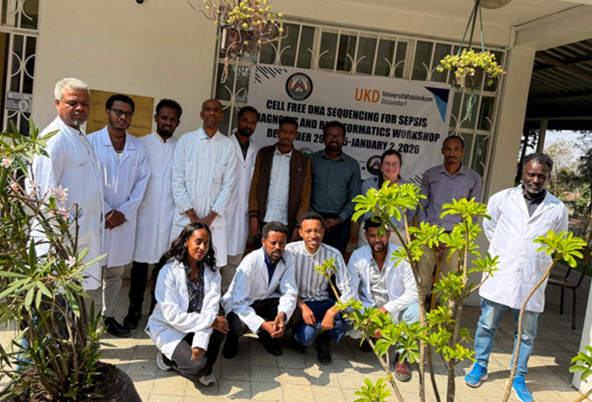
From 29 December 2025 to 5 January 2026, a five-day hands-on workshop on cell-free DNA (cfDNA), based sepsis diagnostics was conducted at HITM within the framework of the ISAVE Project. The workshop focused on sustainable capacity building for advanced molecular diagnostics in resource-limited healthcare settings and was supported by the University Hospital Düsseldorf (UKD). Bioinformatics training and pipeline implementation were led by Anna Rommerskirchen.
Addressing Diagnostic Gaps in Sepsis Care
Sepsis remains a major global health challenge, with particularly high mortality rates in low-resource settings. In Ethiopian referral hospitals, blood culture, the current diagnostic gold standard, is limited by long turnaround times (24–48 hours), low sensitivity (20–40%), and frequent false-negative results, especially in patients who have already received antibiotics. These limitations significantly hinder timely, targeted treatment in critically ill patients.
cfDNA-based diagnostics offer a promising alternative. During infection, microbial cfDNA is released into the bloodstream through bacterial lysis and cell death, while the host inflammatory response leads to increased levels of human cfDNA. Unlike blood culture, cfDNA-based metagenomic sequencing does not require viable pathogens and enables direct, culture-independent detection of both live and dead microorganisms from plasma, substantially reducing diagnostic turnaround time.
Technical Implementation and Sequencing Workflow
During the workshop, participants were trained in the full cfDNA diagnostic workflow. Blood samples were collected in Streck cell-free DNA BCT tubes to stabilize nucleated blood cells and minimize pre-analytical DNA contamination. Plasma separation was performed under standardized conditions, followed by cfDNA extraction using the QIAamp MinElute ccfDNA kit (Qiagen), optimized for short DNA fragments typical of apoptotic and necrotic processes.
Library preparation employed multiplex ligation sequencing, allowing multiple samples to be processed simultaneously in a cost-effective manner. Sequencing was performed using the Oxford Nanopore Technologies MinION platform, selected for its portability, relatively low capital costs, real-time data generation, and minimal infrastructure requirements, features that make it particularly suitable for resource-limited settings. Its long-read capability also offers potential advantages for pathogen identification and antimicrobial resistance gene detection.
Bioinformatics Training and Infrastructure Development
A central component of the workshop was the establishment of on-site bioinformatics capacity. A dedicated sequencing and analysis computer was installed and configured locally, including bioinformatics software, reference databases, and quality-control pipelines. Under the guidance of Anna Rommerskirchen, participants received hands-on training in data processing, pathogen identification, and result interpretation, enabling local teams to independently analyze sequencing data without reliance on external laboratories.
Sustainable Capacity Building Beyond the Workshop
This initiative represents more than a short-term technology transfer. By combining innovative sequencing technology, comprehensive training, and locally anchored infrastructure, the ISAVE project lays the groundwork for sustainable molecular diagnostic capacity in Ethiopia. The established workflows and expertise can be adapted to other infectious disease challenges, contributing to a future in which advanced diagnostics are accessible even in the most resource-constrained healthcare environments.