


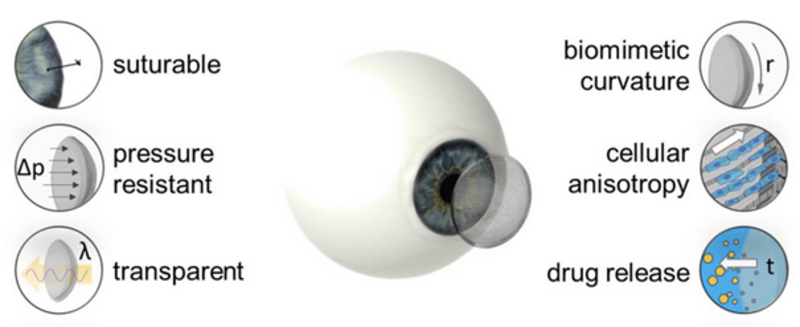
Implants – Donor-Independent Synthetic Corneal Endothelium Replacement
Principle Investigators: Dr. med. Sarah B. Zwingelberg, Dr. Ing. Gregor Lang (University Hospital Würzburg)
For patients with advanced corneal disease where pharmacological therapy is no longer effective, this project offers a groundbreaking solution: a fully synthetic, biomimetic endothelial implant that eliminates the need for donor tissue. These implantable systems combine melt-electro-writing microarchitectures, nanostructured basement membranes, and bioactive hydrogels to create a functional, transparent, and immunocompatible replacement for the human corneal endothelium. Preclinical studies confirm full tissue integration, restored visual clarity, and minimal immune response. Additionally, the implants can be adapted for use in superficial corneal defects, such as amniotic membrane substitutes with integrated nano-drug delivery.
The project is supported by the DFG Priority Program SPP 2416 and protected under both EU and international PCT patents. Click here for more information.
Hormone-Specific Pharmacotherapy for Corneal Diseases
This project pioneers a novel, disease-modifying pharmacological approach to treat corneal disorders, with a primary focus on Fuchs' Endothelial Corneal Dystrophy (FECD) — a chronic degenerative disease predominantly affecting postmenopausal women. The therapy targets hormone-regulated, fibrotic, and mitochondrial pathways using clinically approved drugs repurposed for off-label use. By precisely modulating sex hormone receptors and associated molecular signaling, the aim is to slow or halt disease progression before irreversible cellular damage occurs. Validation is conducted through in vitro and ex vivo models that replicate key pathological features, including cellular senescence and fibrotic reprogramming. The overarching goal is to reduce the need for corneal transplantation and establish a new field of hormone- and sex-specific regenerative ophthalmology.