




Anatomo-functional mapping
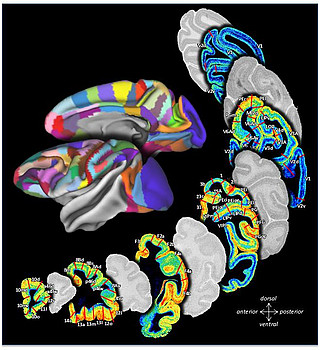
Neurotransmitters and their receptors act as molecular gatekeepers at every synapse, enabling communication between neurons. Zooming out from a single synapse to an entire cortical area, together with the “Receptor” team at the INM-1 Institute at the Research Centre Jülich, we demonstrated that each brain area has its own unique mix of different receptor types — a kind of “molecular profile” or receptor fingerprint. Receptor fingerprints reveal additional aspects of the brain’s organization principles:
Evolutionary origin: they differentiate ancient areas (e.g., hippocampus) from newer neocortical areas (e.g., visual cortex).
Information integration levels: they distinguish regions specialized for one sensory input (e.g., auditory cortex) from those that integrate multiple modalities (e.g., parietal cortex) or support higher cognitive functions (e.g., prefrontal cortex).
Functional systems: functional networks (e.g., somatosensory, motor) show characteristic receptor distribution patterns.
Species similarities and specializations: they identify conserved and divergent brain organization principles across different species.
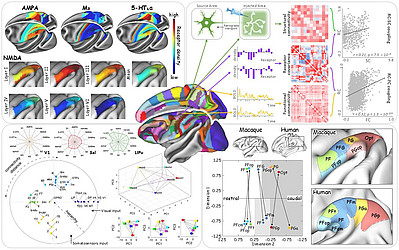
Yet, we still do not fully understand how these local molecular properties scale up to shape the large-scale interactions between brain networks — the very interactions that allow the brain to move from simple sensation to complex cognition. Thus, moving forward, we now combine classical neuroanatomical analyses with modern computational neuroscience, bridging together post-mortem findings with data from living brains, weaving together information that spans vastly different spatial and temporal scales as well as multiple species, to reveal the principles that shape whole-brain network organization.
In this framework, we are building a high-resolution 3D multimodal atlas of the macaque brain, integrating, among others, cyto-, myelo and receptor-architectonic maps, electrophysiological recordings, as well as structural and functional MRI datasets alongside a comprehensive parcellation scheme derived from quantitative multimodal analyses.