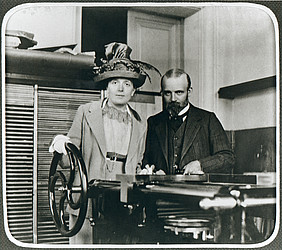


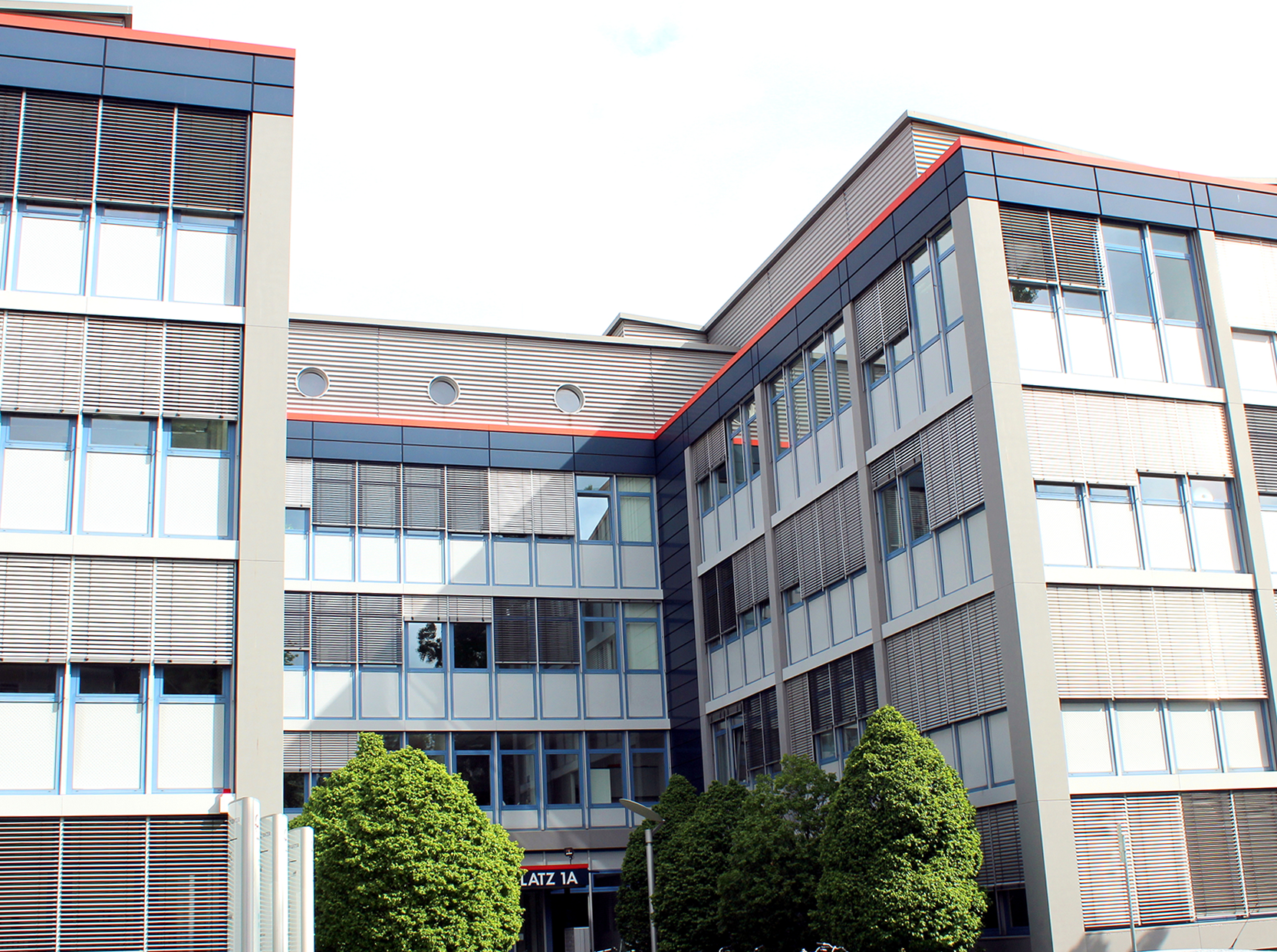




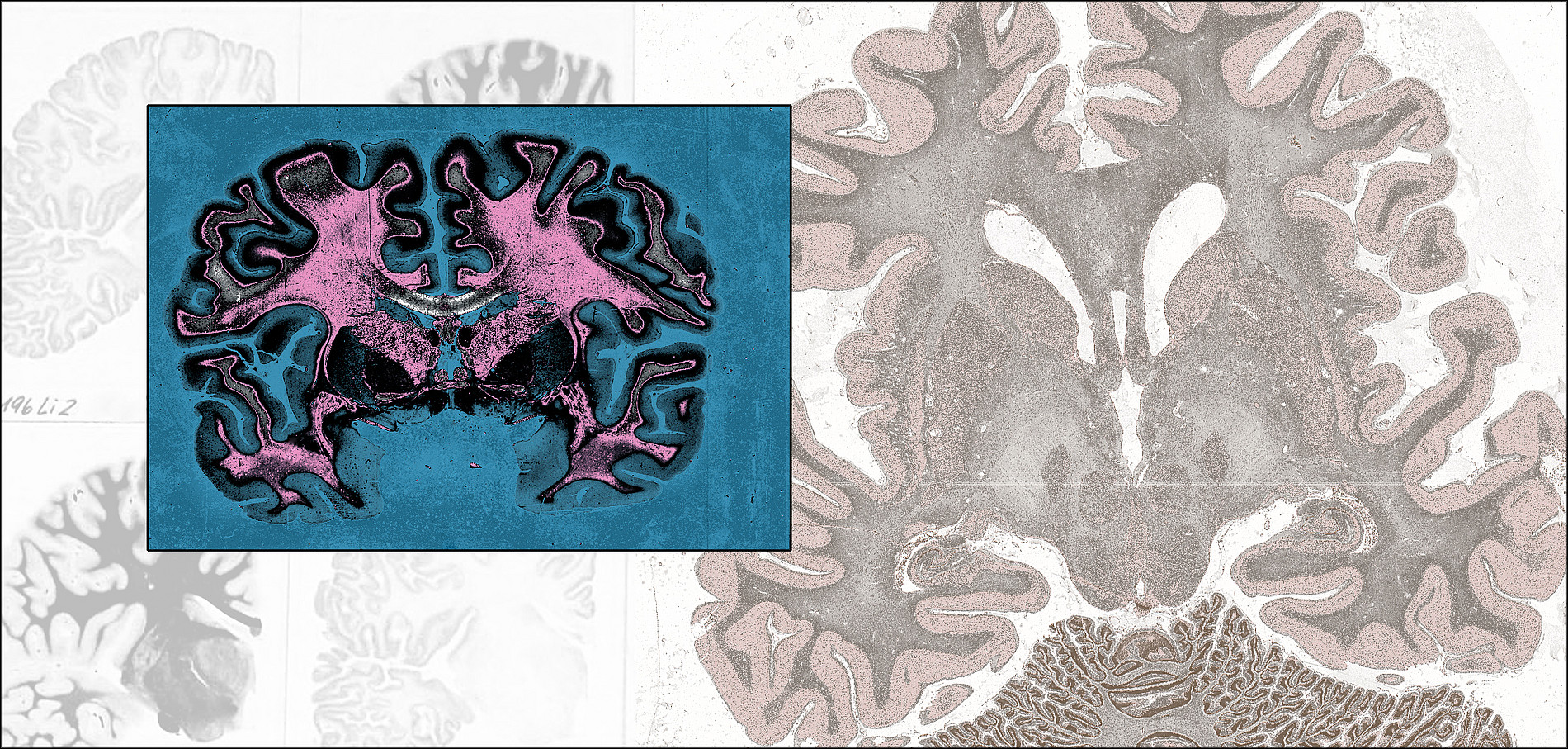
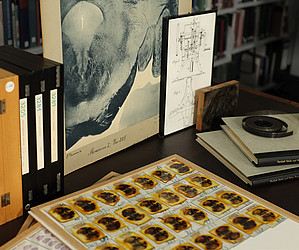
Our C. and O. Vogt Institute of Brain Research hosts the Vogt Collection, the Vogt Archive, as well as several brain section collections. The Vogt Archive comprises a brain and brain section collection as well as the estate of the researcher couple Cécile and Oskar Vogt. The Vogt estate consists of about 70,000 individual pages and includes the institute's files as well as patient records and scientific and private correspondence. In addition, there is a photo archive, a library with about 2,000 book volumes, and a collection of about 20,000 scientific offprints. The collections of Cécile and Oskar Vogt are stored in the Brain Research Institute on about 300 square meters. The Vogt Archive also houses other collections, including those of Dr. Heinz Stephan, Prof. Dr. Dr. Karl Zilles and the current director of our institute, Prof. Dr. Katrin Amunts. The collections are stored in the Institute for Brain Research on over 500 square meters.
The use of the private archive and the collections for scientific purposes is possible after submitting a user request. Please contact our team regarding this. A lead time of four weeks is assumed. The archive is not open to the public.
Inquiries by e-mail to vogt-archiv@uni-duesseldorf.de
Exhibition Announcement: Benno Reifenberg in the 'Castle of Brains' of the Vogts
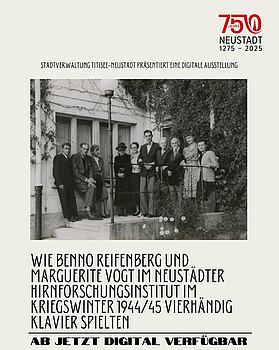
We are pleased to draw your attention to the virtual exhibition: ‘Beethoven Against Hunger, Bruckner Against the Cold. How Benno Reifenberg and Marguerite Vogt Played Four-Hand Piano at the Brain Research Institute in Neustadt During the War Winter of 1944/45.’
The exhibition tells the story of how the feuilleton journalist Benno Reifenberg found refuge at the institute of Cécile and Oskar Vogt in Neustadt in 1944/45. The Institute of Brain Research and General Biology had been established by the Vogts after they were forced to leave Berlin in 1937 under pressure from the National Socialists. Known by local residents as ‘he Castle of Brains’, the institute relocated in 1965 to the newly founded University of Düsseldorf, becoming the predecessor of today’s Cécile and Oskar Vogt Institute of Brain Research at the University Hospital Düsseldorf.
As managing editor of the Frankfurter Zeitung, Benno Reifenberg was among the most prominent liberal journalists of the Weimar Republic. After the newspaper was banned in 1943, he worked in the brain researchers’ laboratory together with Vogts’ daughter Marguerite, with whom he gave evening four-hand piano performances. The remote institute in the Black Forest is described by the exhibition’s curators as a ‘unique intellectual biotope’. Former staff members such as Igor Klatzo also recalled its special atmosphere, describing it as a ‘magic mountain’. After the war, Reifenberg founded Die Gegenwart in 1945, which became the most widely read magazine until the establishment of the early Federal Republic of Germany, and in 1959 he became a co-publisher of the Frankfurter Allgemeine Zeitung (FAZ). He reflected on his time in Neustadt in his book ‘Oskar Vogt – My Confrontation with Natural Science’.
The exhibition is part of the German Digital Library’s offerings and was created in 2025 as part of Neustadt’s anniversary year.
The Julich Brain Atlas and the “Telematic Society”
“Between Image and Language – Thinking in the Telematic Society” is the title of the lecture by Professor Katrin Amunts on Tuesday, November 25, 2025, at the North Rhine-Westphalian Academy of Sciences, Humanities and the Arts in Düsseldorf. The background is the utopia of a “telematic society,” conceived by media philosopher Vilém Flusser more than forty years ago. In such a society, human and technical communication systems are inseparably intertwined. According to this utopian vision, a world so thoroughly digitalized would itself digitalize human thought and radically transform the symbols of human exchange.
The event begins at 6:30 p.m. at the Academy’s headquarters, Palmenstraße 16, 40217 Düsseldorf. Registration: anmeldung@awk.nrw.de .
Please find further information on their website.
Why two pioneers of brain research never received the Nobel Prize
A new article in Frontiers in Neuroanatomy examines the scientific legacy of Cécile and Oskar Vogt. Their joint work shaped modern brain research—yet they never received the Nobel Prize, despite numerous nominations. Authors Nils Hansson, Heiner Fangerau, Fabio De Sio, Ursula Grell, and Katrin Amunts draw on archival sources from the Nobel Forum in Sweden and the Vogt Archive in Düsseldorf to understand why the research couple was nominated repeatedly over decades, yet the Nobel Prize Committee always decided otherwise. The article also reflects on how the Vogts' work lives on in modern neuroscience. The article was written in collaboration with researchers from the C. u. O. Vogt Institute for Brain Research, the Vogt Archive, and the Institute for the History, Theory, and Ethics of Medicine at Düsseldorf University Hospital.
https://www.frontiersin.org/journals/neuroanatomy/articles/10.3389/fnana.2025.1679993/full
Nils Hansson, Heiner Fangerau, Fabio De Sio, Ursula Grell and Katrin Amunts (2025). Pioneers of modern brain research—Cécile and Oskar Vogt and the Nobel Prize. Front. Neuroanat. 19:1679993. doi: https://doi.org/10.3389/fnana.2025.1679993